You’ve had a scrotal ultrasound and received a report full of numbers, terms like “pampiniform plexus,” “retrograde flow,” and “Valsalva maneuver.” What does it all mean for your fertility, your pain, and your treatment options? Most patients never get a proper explanation of their imaging results, which leads to confusion, anxiety, and missed follow-up. This guide breaks down exactly how to read a varicocele Doppler ultrasound report in plain language, what each finding means clinically, and how it influences your next steps in 2026.
What Is a Scrotal Doppler Ultrasound?
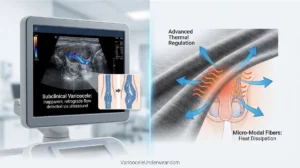
A scrotal Doppler ultrasound is a non-invasive imaging test that combines standard grayscale ultrasound (to visualize structures) with color Doppler technology (to detect and measure blood flow direction and velocity). For varicocele evaluation, it assesses the pampiniform plexus (the network of veins around the testis) for abnormal dilation and retrograde (backward) blood flow. It is the gold standard diagnostic tool for varicocele and is recommended by both the AUA and European Association of Urology for any man with suspected varicocele, scrotal pain, or male infertility.
The test is performed with the patient standing and lying down, and includes a Valsalva maneuver (bearing down as if having a bowel movement), which increases intra-abdominal pressure and provokes venous reflux if valve incompetence exists.
Key Numbers on Your Ultrasound Report
Vein Diameter
The most important measurement is the maximum diameter of veins in the pampiniform plexus. Here’s how to interpret it:
| Vein Diameter | Classification | Clinical Significance |
|---|---|---|
| Under 2.5 mm | Normal | No varicocele |
| 2.5 – 3.0 mm | Borderline / Subclinical | Possible subclinical varicocele; Valsalva reflux determines significance |
| 3.0 – 3.9 mm | Grade 1 clinical | Palpable only on Valsalva; mild varicocele |
| 4.0 – 4.9 mm | Grade 2 | Palpable at rest without Valsalva |
| 5.0 mm or more | Grade 3 | Visible through scrotum; significant venous dilation |
Note that the 3mm cutoff is a guideline, not a hard rule. Clinical context, reflux characteristics, and symptoms all matter. A 2.8mm vein with significant Valsalva reflux may be more functionally significant than a 3.2mm vein with minimal reflux.
Retrograde Flow / Valsalva Reflux
This is arguably more important than vein diameter alone. “Retrograde flow” means blood is flowing backward (down toward the testicle) instead of upward toward the heart. On your report, this appears as color change on Doppler (typically red to blue or vice versa during Valsalva) or is described in the findings section.
- Reflux duration under 1 second: Physiologically normal; most healthy men show brief reflux on Valsalva
- Reflux duration 1-2 seconds: Borderline; clinical correlation required
- Reflux duration over 2 seconds: Pathological; consistent with clinically significant varicocele
- Continuous spontaneous reflux: Severe varicocele with persistent retrograde flow even at rest
Research published in the Journal of Ultrasound in Medicine established these reflux duration thresholds as the most reliable Doppler criteria for varicocele grading, and they remain the standard in 2026 reporting.

Discover specialized varicocele underwear designed for daily comfort, support, and recovery — a more targeted option for men who want support without compromise.
Discover the Recommended OptionUnderstanding Left vs. Right Side Findings
Your report will specify findings on the left, right, or both sides. Approximately 90% of varicoceles are left-sided due to the anatomy of the left testicular vein (perpendicular drainage into the renal vein vs. the right side’s oblique drainage into the IVC). Left-sided findings are expected and typically straightforward.
If your report mentions a right-sided varicocele or bilateral varicoceles, pay close attention. Isolated right varicocele or bilateral disease with sudden onset warrants further abdominal imaging to rule out vascular compression or kidney pathology. A right varicocele in isolation on Doppler should always prompt a conversation with your urologist about secondary causes.
Testicular Volume Measurement: Why It Matters
Most varicocele ultrasound reports include testicular volume measurements for both sides, typically calculated using the Lambert formula: length x width x height x 0.71. Normal adult testicular volume is 15-25 mL per testis. A volume difference between left and right of more than 2 mL (or more than 20% discrepancy) is considered clinically significant and suggests varicocele-related testicular atrophy.
Ipsilateral testicular atrophy (the affected testicle being smaller) is one of the clearest indications for varicocele treatment in adolescents and young adults. If your report shows left testicular volume significantly smaller than the right, discuss this finding specifically with your urologist in the context of treatment decisions.
What “Echogenicity” and Texture Descriptions Mean
Radiologists describe the internal texture of the testicle as “homogeneous” (uniform) or “heterogeneous” (patchy or uneven). Homogeneous echotexture is normal. Heterogeneous echotexture can indicate inflammation, prior infection, torsion injury, or in rare cases, early malignancy. If your report includes heterogeneous testicular echogenicity, that’s a finding to discuss, not panic about, but definitely not ignore.
Epididymal findings (head, body, tail of the epididymis) are also reported and relevant for ruling out epididymo-orchitis, cysts, or obstruction that could co-exist with varicocele and independently affect fertility.
How Doppler Findings Connect to Your Fertility Workup
Ultrasound findings alone don’t tell the full fertility story. The imaging needs to be integrated with your semen analysis and ideally sperm DNA fragmentation testing. A Grade 2 varicocele with 3-second Valsalva reflux and a left testis 3 mL smaller than the right, combined with low sperm motility and high SDF, paints a very different clinical picture than the same imaging findings with a normal semen analysis.
The relationship between varicocele and male fertility is multifactorial; ultrasound is one piece of a diagnostic puzzle that also includes hormonal assessment (FSH, LH, testosterone), semen parameters, and clinical examination. Understanding each piece helps you ask better questions and make more informed treatment decisions.
Questions to Ask Your Doctor After Getting Doppler Results
- What is the maximum vein diameter found, and does it meet the threshold for clinical varicocele?
- Was retrograde flow detected, and for how long during Valsalva?
- Is there a volume difference between my testicles, and is it clinically significant?
- Was any right-sided reflux found, and does that require additional abdominal imaging?
- Based on these findings and my semen analysis, do you recommend treatment, monitoring, or additional testing?
- Should I get a sperm DNA fragmentation test given these imaging results?
Getting answers to these specific questions will help you understand your varicocele grade and what severity means for treatment options. It also helps you determine whether varicocele surgery is actually needed in your specific case.
Can You Repeat a Doppler Ultrasound?
Yes, and sometimes you should. Scrotal Doppler ultrasound is safe, non-invasive, and has no radiation exposure. Repeat imaging is appropriate for monitoring subclinical or Grade 1 varicoceles over time, assessing response after treatment, evaluating new or worsening symptoms, and checking for recurrence after embolization or surgery. There’s no clinical reason to avoid repeat imaging when the clinical picture changes.
For men managing symptoms conservatively while monitoring imaging findings, cooling and supportive varicocele underwear reduces day-to-day venous pressure and scrotal temperature, addressing two of the primary mechanisms through which varicocele damages sperm and causes pain. Pairing conservative measures with consistent follow-up imaging is a reasonable strategy for men with mild-to-moderate findings who are not yet surgical candidates.
FAQ: Doppler Ultrasound for Varicocele
What does “Grade 1 varicocele with Valsalva reflux” mean on my report?
A Grade 1 varicocele is the mildest clinical form, only palpable during the Valsalva maneuver. “With Valsalva reflux” confirms that backward blood flow is detected when you bear down, confirming valve incompetence. Whether this needs treatment depends on symptoms, semen parameters, and testicular volume, not the grade alone.
My ultrasound says “bilateral varicoceles” – should I be concerned?
Bilateral varicoceles exist but are less common than left-sided only. If both sides are involved, the fertility impact can be greater since both testes may experience thermal and oxidative stress. Right-sided varicocele also warrants abdominal imaging to rule out secondary causes. Discuss both findings separately with your urologist.
How accurate is Doppler ultrasound for diagnosing varicocele?
Studies report sensitivity of 97% and specificity of 94% for color Doppler ultrasound in varicocele diagnosis when performed by experienced sonographers using standardized protocols. Accuracy drops significantly with poor technique, inadequate patient positioning, or failure to perform the Valsalva maneuver. If results feel inconsistent with symptoms, a repeat scan at a specialized center is justified.
Related Articles


Choose Varicocele Support Designed for Cooling, Lift, and Daily Comfort
You’ve seen why regular underwear often falls short. Now view the purpose-built option made to reduce heaviness, improve support, and feel comfortable enough for everyday wear.