If you have varicocele, you’ve probably been told to avoid prolonged sitting. But then you read that standing desks are the healthy alternative, so you bought one, stood all day, and your scrotal ache got worse. Welcome to one of the most practical and least-discussed dilemmas in varicocele management: standing actually worsens venous pooling in the pampiniform plexus more reliably than sitting does. This article cuts through the desk ergonomics marketing to explain what the vascular physiology actually says, which position is worse for varicocele and when, and how to structure your workday to minimize venous pressure throughout the day.
Why Static Standing Is Worse Than Sitting for Varicocele
Varicocele pain characteristically worsens with prolonged standing and improves when lying down. This is a diagnostic criterion, not a coincidence. The reason is hydrostatic pressure. When you stand upright, the full column of blood in the testicular vein exerts gravitational pressure downward toward the pampiniform plexus. In a healthy venous system, competent valves interrupt this column and prevent pooling. In varicocele, those valves are faulty, so the entire hydrostatic load bears down on already-dilated scrotal veins.
A standing desk that has you stationary on your feet for 2-4 hours at a stretch replicates the exact hemodynamic conditions that produce maximum varicocele symptom burden. The only thing worse than static standing is static standing combined with heat, which is why factory floors, retail jobs, and kitchen work are so reliably symptomatic for men with varicocele.
Why Prolonged Sitting Also Causes Problems
Sitting doesn’t generate the same hydrostatic venous pressure as standing, but it creates a different problem: hip flexion compresses the femoral and iliac veins at the groin crease, increasing venous back-pressure in the pelvic region. This impairs drainage from the testicular venous system from above rather than below. Additionally, prolonged sitting eliminates the calf muscle pump, which in a standing or walking person continuously drives venous blood upward from the lower extremities.
Scrotal temperature also rises significantly during prolonged sitting. A 2018 study found that sitting for 60 minutes on a standard office chair raised scrotal temperature by approximately 1.5-2°C compared to baseline, a meaningful elevation given that even 0.5°C of sustained scrotal temperature increase impairs spermatogenesis. The relationship between heat stress and varicocele fertility impact makes this temperature rise clinically significant, not just uncomfortable.

Discover specialized varicocele underwear designed for daily comfort, support, and recovery — a more targeted option for men who want support without compromise.
Discover the Recommended OptionDirect Comparison: Standing Desk vs. Sitting Desk for Varicocele
| Factor | Static Standing Desk | Standard Sitting Desk |
|---|---|---|
| Hydrostatic venous pressure | High (gravity full column effect) | Moderate (gravity partially offset) |
| Scrotal temperature | Moderate (air circulation helps) | Higher (trapped heat, fabric contact) |
| Calf muscle pump | Present if shifting weight | Absent in static seated position |
| Femoral vein compression | Absent | Present at hip crease |
| Pain on Valsalva (standing) | Direct aggravation | Less direct |
| Overall varicocele symptom load | Higher in symptomatic men | High with prolonged immobility |
The verdict: for symptomatic varicocele, static standing is generally worse than sitting, but both are problematic when sustained for long periods without movement breaks.
The Optimal Solution: Dynamic Position Alternation
The research on sit-stand desk use in general ergonomics consistently shows that alternating positions every 30-45 minutes produces better musculoskeletal and vascular outcomes than either static posture. For varicocele patients, this principle applies with additional urgency. The goal is to prevent the accumulation of venous pooling that occurs when any one position is sustained for extended periods.
A practical protocol for a varicocele-friendly workday:
- Sit for 25-30 minutes in a properly adjusted chair (hips at or above knee level, lumbar support)
- Stand and walk for 5-10 minutes: walk to get water, use a bathroom on a different floor, do calf raises at the desk
- Stand at desk for 15-20 minutes with anti-fatigue mat and weight-shifting movement
- Repeat the cycle throughout the workday
- Legs Up the Wall for 10 minutes at lunch: most impactful single intervention for midday venous reset
Chair Setup Matters More Than Standing Desk Choice
If budget forces a choice between optimizing a sitting setup versus buying a standing desk, optimizing the chair is more valuable for varicocele patients. Key adjustments that reduce pelvic venous pressure while seated:
- Seat height: hips should be at or slightly above knee level; seat too low increases hip flexion and femoral vein compression
- Seat depth: 2-3 finger-widths between seat edge and back of knees prevents popliteal vein compression
- Seat tilt: a slight forward tilt (5-10 degrees) reduces hip flexion angle and opens the groin crease, improving femoral venous flow
- No seat edge pressure: avoid chairs that dig into the back of the thigh, which directly compresses the femoral vein
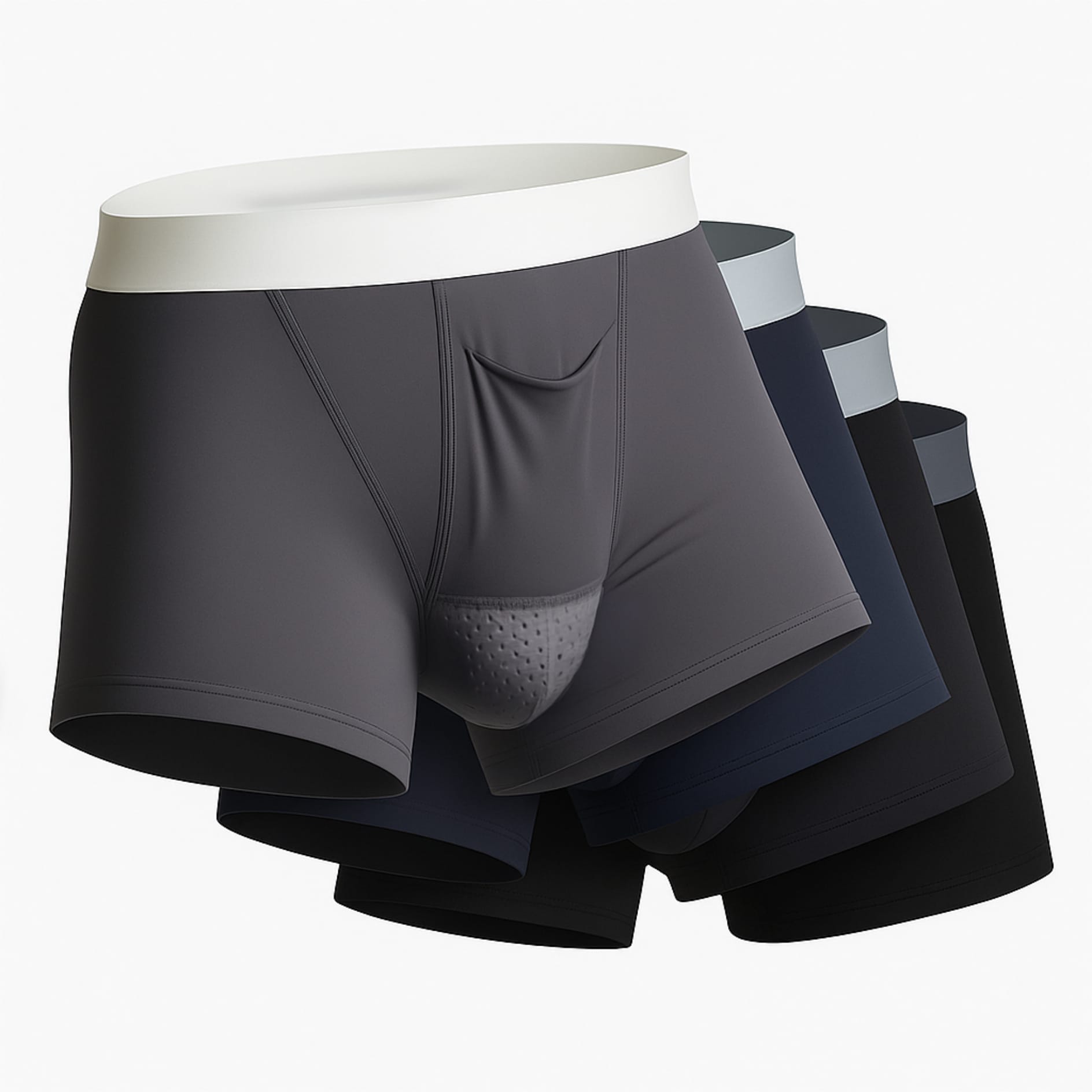
Pair any desk setup with cooling and supportive varicocele underwear during the workday. Scrotal support reduces gravitational venous pooling in both sitting and standing positions, and the cooling component addresses the temperature elevation that both postures generate. This is the most practical single investment for men with desk jobs and varicocele.
Anti-Fatigue Mats and Footrests: Do They Help?
Anti-fatigue mats for standing desks encourage subtle weight-shifting and micro-movement that partially activates the calf muscle pump. For varicocele patients using standing desks, an anti-fatigue mat is a worthwhile addition because the low-level continuous movement it promotes is meaningfully better than completely static standing. A footrest for the seated position allows alternate leg elevation throughout the day, reducing femoral compression on the elevated side.
Understanding how varicocele symptoms can be reduced without surgery through environmental and postural adjustments gives men with desk jobs a comprehensive toolkit that doesn’t require waiting for medical intervention.
FAQ: Standing Desk vs. Sitting and Varicocele
I bought a standing desk for my varicocele and my pain got worse. Why?
This is the most common feedback from varicocele patients who switch to standing desks without understanding the hemodynamics. Static standing worsens gravitational venous pooling in the pampiniform plexus more than sitting does, because the full hydrostatic column of blood in the testicular vein bears directly downward. Use the standing desk dynamically (alternating positions every 30 min) rather than as a replacement for all sitting.
Does the type of flooring matter for standing desk varicocele pain?
Hard floors (concrete, hardwood) without cushioning force rigid static postures and eliminate micro-movement. Anti-fatigue mats or cushioned standing mats allow subtle weight-shifting that partially activates the calf pump and reduces the degree of static venous pooling. If you’re using a standing desk for periods during the day, a quality anti-fatigue mat is a small investment that makes a measurable difference in lower limb venous return.
What is the maximum time I should sit or stand without movement breaks?
For varicocele management, 30-45 minutes is the practical maximum for either static position before a movement break. Movement doesn’t need to be extended: 3-5 minutes of walking or calf raises is sufficient to activate the venous pump and reset lower limb and pelvic venous pressure. Setting a recurring timer is the simplest and most consistently effective implementation strategy.
Related Articles
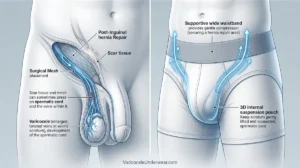


Choose Varicocele Support Designed for Cooling, Lift, and Daily Comfort
You’ve seen why regular underwear often falls short. Now view the purpose-built option made to reduce heaviness, improve support, and feel comfortable enough for everyday wear.