Most discussions of scrotal support for varicocele focus on comfort. Almost none explain the actual physics of why upward suspension reduces vein pressure in the pampiniform plexus, or how much pressure reduction you can realistically achieve through mechanical support. Understanding the biomechanics helps you make better choices about support garment design, wearing habits, and the positions that minimize venous pressure throughout your day. This article covers the fluid mechanics of scrotal venous pressure, how suspension alters that pressure, and what the physical principles mean for practical daily management.
Hydrostatic Pressure in the Pampiniform Plexus
The pampiniform plexus is a network of veins surrounding the testis. In a standing man, blood must return from these veins upward through the spermatic cord to the renal vein (left side) or directly to the inferior vena cava (right side). Venous pressure at any point in a fluid column is determined by: P = ρgh, where ρ is blood density (~1,050 kg/m³), g is gravitational acceleration (9.8 m/s²), and h is the height of the fluid column above the measurement point.
In a standing man of average height, the distance from the scrotum to the left renal vein is approximately 30-40 cm. This creates a hydrostatic pressure of roughly 22-29 mmHg that the testicular vein valves must overcome to prevent retrograde flow. In a healthy man with competent valves, this pressure is managed. In varicocele, the incompetent valves allow this pressure to drive retrograde flow, filling the pampiniform plexus with blood that should be moving upward. Every centimeter of additional scrotal descent increases this hydrostatic column and worsens reflux.
How Upward Suspension Reduces Venous Pressure
When a support garment lifts the scrotum upward by, say, 3-4 cm from its unsupported hanging position, it shortens the hydrostatic fluid column between the pampiniform plexus and the renal vein by that same distance. Using the hydrostatic pressure formula, each centimeter of scrotal elevation reduces venous pressure at the pampiniform plexus level by approximately 0.77 mmHg (ρgh with h = 1cm). A 4cm elevation therefore reduces hydrostatic pressure by approximately 3 mmHg at the plexus level.
This may seem modest, but consider the context: in men with subclinical varicocele, the reno-caval pressure gradient threshold for hemodynamically significant disease is approximately 3 mmHg. A well-fitted support garment producing 4cm of sustained scrotal elevation comes close to offsetting the pressure gradient that defines pathological venous reflux. For men with Grade 1-2 varicocele, this pressure reduction can mean the difference between symptomatic and asymptomatic venous reflux throughout the day.

Discover specialized varicocele underwear designed for daily comfort, support, and recovery — a more targeted option for men who want support without compromise.
Discover the Recommended Option| Scrotal Position | Approximate Column Height (cm) | Hydrostatic Pressure (mmHg) | Reflux Risk |
|---|---|---|---|
| Unsupported standing | 35-40cm | ~27-31 mmHg | Highest |
| Supported standing (4cm lift) | 31-36cm | ~24-28 mmHg | Moderately reduced |
| Seated (hips at 90°) | ~15-20cm effective | ~12-15 mmHg | Moderate |
| Supine (lying flat) | ~0cm | ~0-2 mmHg | Minimal |
| Legs elevated (Legs Up Wall) | Negative column | Negative (gravity-assisted drainage) | Near zero |
The Geometry of Support: Lift vs. Compression
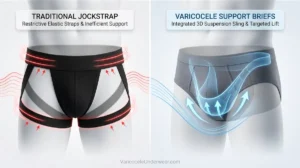
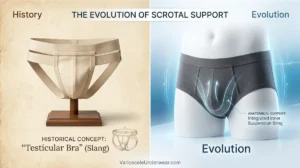
Not all scrotal support is equal from a pressure-reduction standpoint. The critical distinction is between upward lift (which shortens the hydrostatic column and reduces venous pressure) and lateral compression (which squeezes the veins but can paradoxically increase venous resistance and worsens pooling if the outflow tract is compressed simultaneously). Well-designed varicocele support achieves the former while avoiding the latter.
Garments that compress the inguinal region at the top of the pouch risk constricting the spermatic cord outflow, which partially negates the benefit of scrotal elevation. The optimal support architecture provides firm upward elevation of the scrotal contents without tight band pressure across the inguinal canal or the base of the scrotum where the spermatic cord exits. This is why the design geometry of the support pouch matters more than its firmness alone for varicocele-specific applications.
Positional Strategies That Maximize Pressure Reduction
The pressure table above illustrates that lying with legs elevated is the most powerful mechanical intervention available. The best sleep and rest positions for varicocele take advantage of this physics: even a 15-degree leg elevation from the supine position creates a mild negative hydrostatic gradient that actively assists venous drainage from the scrotum toward the heart.
During waking hours when standing or sitting is unavoidable, the combination of upward scrotal support (from a well-designed support garment like the varicocele support underwear) and regular movement breaks addresses venous pressure continuously. The support reduces the static hydrostatic pressure burden, while movement activates the calf muscle pump to drive venous return from the lower extremity, indirectly reducing pelvic venous back-pressure.
Why Varicocele Pain Worsens Throughout the Day
The progressive nature of varicocele pain, characteristically worse in the evening after a day of standing or activity and better in the morning after overnight recumbency, is a direct consequence of the hydrostatic pressure physics described above. Each hour of standing allows incremental venous pooling in the pampiniform plexus. The dilated veins fill progressively throughout the day as the cumulative effect of gravitational pressure overcomes the (already compromised) valve resistance. By evening, venous engorgement reaches its maximum for that day.
Overnight in the supine position, with zero hydrostatic pressure and passive venous drainage, the pampiniform plexus partially decompresses. Morning pain relief reflects this overnight decompression. Understanding this cycle helps explain why daily support is more effective than occasional support: consistently reducing the daytime hydrostatic burden prevents the evening engorgement peak rather than simply managing its aftermath. The full range of non-surgical symptom reduction strategies builds on this physical foundation.
FAQ: Physics of Scrotal Support
Does scrotal support actually reduce venous reflux measurably?
Physical reduction in hydrostatic pressure through scrotal elevation is mathematically demonstrable and consistent with the clinical observation that varicocele pain improves with scrotal support in the vast majority of men. Direct Doppler measurement of reflux with and without support has not been extensively studied in controlled trials, but the fluid mechanics are unambiguous: shortening the hydrostatic column reduces the pressure driving reflux through incompetent valves.
Why does my varicocele feel worse in hot weather?
Heat causes peripheral vasodilation, increasing blood volume in superficial vessels including the pampiniform plexus. Hot weather also increases scrotal temperature above the already-elevated varicocele baseline, compounding both the vascular engorgement and the thermal sperm damage mechanisms simultaneously. This double effect explains the common experience of significantly worsened varicocele symptoms during summer months or in hot climates.
Does elevation height matter – is a 2cm lift significantly worse than a 4cm lift?
Yes. Using the hydrostatic pressure formula, the difference between 2cm and 4cm of elevation is approximately 1.5 mmHg of pressure reduction. In the context of the 3 mmHg threshold that defines hemodynamically significant varicocele pressure gradients, doubling the elevation from 2cm to 4cm roughly doubles the pressure-reduction benefit. Support garment architecture that achieves maximum anatomically appropriate elevation provides disproportionately greater physiological benefit than minimal-lift designs.
Related Articles
Choose Varicocele Support Designed for Cooling, Lift, and Daily Comfort
You’ve seen why regular underwear often falls short. Now view the purpose-built option made to reduce heaviness, improve support, and feel comfortable enough for everyday wear.