You had varicocele surgery. A week later, the incision looks fine but your scrotum is swollen in a way that wasn’t there before. Is this normal post-operative swelling that will resolve, or is it the beginning of a hydrocele, the most common complication after varicocele repair? Knowing the difference matters because hydrocele requires a separate procedure to fix if it becomes significant, while normal post-surgical swelling requires only patience. This guide explains how to tell them apart, what timeline is acceptable for each, and when to call your surgeon.
What Is Normal Post-Operative Swelling After Varicocele Surgery?
Surgical handling of the spermatic cord during varicocelectomy inevitably causes some degree of local inflammation and edema (fluid accumulation) in the scrotal and inguinal tissues. This is a normal healing response. The scrotum may appear mildly to moderately swollen, feel warm to the touch, and ache diffusely for the first 1-2 weeks after surgery. The swelling is typically soft, diffuse, and does not transilluminate (does not glow uniformly when a light is pressed against it in a dark room).
Normal post-operative edema begins subsiding by day 7-10 and is usually largely resolved by week 3-4. It is not perfectly smooth or cystic in character and does not feel like a separate fluid-filled structure alongside or separate from the testicle. For men managing this period, the guide to sleeping after varicocelectomy addresses positioning strategies that reduce overnight swelling accumulation.
What Is a Post-Operative Hydrocele?
A hydrocele is an abnormal accumulation of fluid within the tunica vaginalis, the thin membrane surrounding the testicle. After varicocele surgery, hydrocele forms when the lymphatic vessels of the spermatic cord are inadvertently ligated (cut or blocked) along with the dilated veins. Without functioning lymphatics to drain the space around the testicle, fluid accumulates. This is why lymphatic preservation is a key technical objective of microsurgical varicocelectomy, and why the complication rate is significantly lower with microsurgery (1-2%) than with laparoscopic approaches (3-10%).

Discover specialized varicocele underwear designed for daily comfort, support, and recovery — a more targeted option for men who want support without compromise.
Discover the Recommended OptionPost-operative hydrocele typically becomes apparent 2-6 weeks after surgery, after the initial inflammatory swelling has partially resolved. It presents as a smooth, tense, cystic mass filling the hemiscrotum and wrapping around the testicle. The classic physical sign is transillumination: when a flashlight or phone torch is pressed firmly against the swollen scrotum in a dark room, a hydrocele will glow with diffuse transmitted light because it is filled with clear fluid. Solid masses (hematocele, tumor) and inflammatory edema do not transilluminate.
| Feature | Normal Post-Op Swelling | Developing Hydrocele |
|---|---|---|
| Onset | Immediate post-op, days 1-7 | Typically weeks 2-6 post-op |
| Character | Diffuse, soft, warm, tender | Smooth, tense, cystic, non-tender |
| Transillumination | Negative | Positive (glows with light) |
| Trend over time | Progressively improving | Stable or growing |
| Location relative to testicle | Surrounding tissue | Fluid specifically around testicle |
| Testicle palpable within | Yes | Often difficult to feel testicle |
How Common Is Post-Varicocelectomy Hydrocele?
Hydrocele is the most common complication of varicocele surgery across all techniques. Rates vary significantly by surgical approach and surgeon experience: microsurgical varicocelectomy at experienced centers produces hydrocele in approximately 1-2% of cases, while laparoscopic varicocelectomy rates range from 3-10%, and high ligation (Palomo procedure) has historically carried rates of 7-33% without intentional lymphatic preservation. Multiple meta-analyses confirm that lymphatic preservation using intraoperative magnification is the single most important technical factor in reducing hydrocele risk.
Some surgeons use intraoperative lymphatic mapping with isosulfan blue dye injection into the scrotum before surgery to visually identify lymphatic channels and avoid cutting them. Centers offering this technique report hydrocele rates below 1%. If hydrocele prevention is a priority for you, ask your surgeon specifically whether they use lymphatic sparing techniques and what their personal hydrocele rate is at 6-month follow-up.
Will a Post-Operative Hydrocele Resolve on Its Own?
Small hydroceles (under 100ml by ultrasound measurement) that develop after varicocele surgery have a reasonable chance of spontaneous resolution within 6-12 months as residual lymphatic channels establish alternative drainage pathways. Watchful waiting with supportive underwear and ultrasound monitoring at 3 and 6 months is appropriate for small, asymptomatic hydroceles.
Large or symptomatic hydroceles (tension hydrocele causing pain or discomfort, hydroceles over 200ml) are unlikely to resolve without intervention. Options include aspiration (needle drainage, simple but high recurrence rate) and hydrocelectomy (surgical repair, definitive solution). This is a separate operation from the varicocele repair and carries its own recovery period. For men comparing varicocele treatment risks and benefits upfront, the varicocele treatment cost vs. risks analysis includes hydrocele formation as a key complication to factor into the decision-making process.
What to Do If You Suspect a Hydrocele Is Forming
- Perform the transillumination test at home in a dark room with a flashlight pressed firmly against the swelling; uniform light transmission (glowing) strongly suggests fluid
- Contact your surgeon to report the finding; do not wait for your routine follow-up if the swelling is growing or becoming uncomfortable
- Request a scrotal ultrasound if the clinical picture is unclear; ultrasound definitively distinguishes hydrocele (anechoic fluid collection) from edema, hematocele (blood-filled), or other pathology
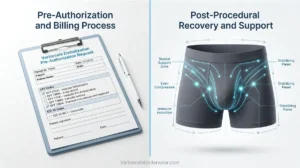
- Wear firm scrotal support (not tight compression): supportive underwear like the varicocele support underwear reduces gravitational pooling of hydrocele fluid and improves comfort during the monitoring period
- Avoid heavy lifting until the hydrocele is evaluated; increased intra-abdominal pressure can worsen fluid accumulation
FAQ: Post-Surgical Swelling and Hydrocele
My scrotum is still swollen 4 weeks after varicocele surgery. Is this normal?
Mild residual swelling at 4 weeks is within normal range for some patients, particularly after more extensive dissection or if there was significant intra-operative bleeding. However, if the swelling is increasing, becoming more tense and cystic, or showing positive transillumination, it should be evaluated with an ultrasound rather than assumed to be normal post-operative edema. A physical exam and ultrasound at this point will give a definitive answer.
Can I prevent hydrocele from forming after varicocele surgery?
The primary prevention is surgical technique: requesting a high-volume microsurgeon who uses lymphatic sparing techniques significantly reduces your personal risk. Post-operatively, wearing supportive underwear consistently, avoiding heavy lifting for the recommended period, and following the post-varicocelectomy underwear and recovery guide supports healing in ways that may reduce the degree of lymphatic disruption during early recovery.
Is a hydrocele dangerous after varicocele surgery?
Post-operative hydrocele is not dangerous in the acute sense; it does not threaten the testicle’s survival or blood supply. It is uncomfortable, cosmetically bothersome, and can cause a dull ache from fluid tension. The significance depends on size and progression. Small hydroceles that remain stable are often watched; growing or symptomatic ones require intervention. They do not recur varicocele or reverse the fertility benefits of the original surgery.
Related Articles
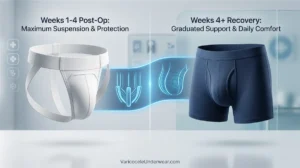

Choose Varicocele Support Designed for Cooling, Lift, and Daily Comfort
You’ve seen why regular underwear often falls short. Now view the purpose-built option made to reduce heaviness, improve support, and feel comfortable enough for everyday wear.