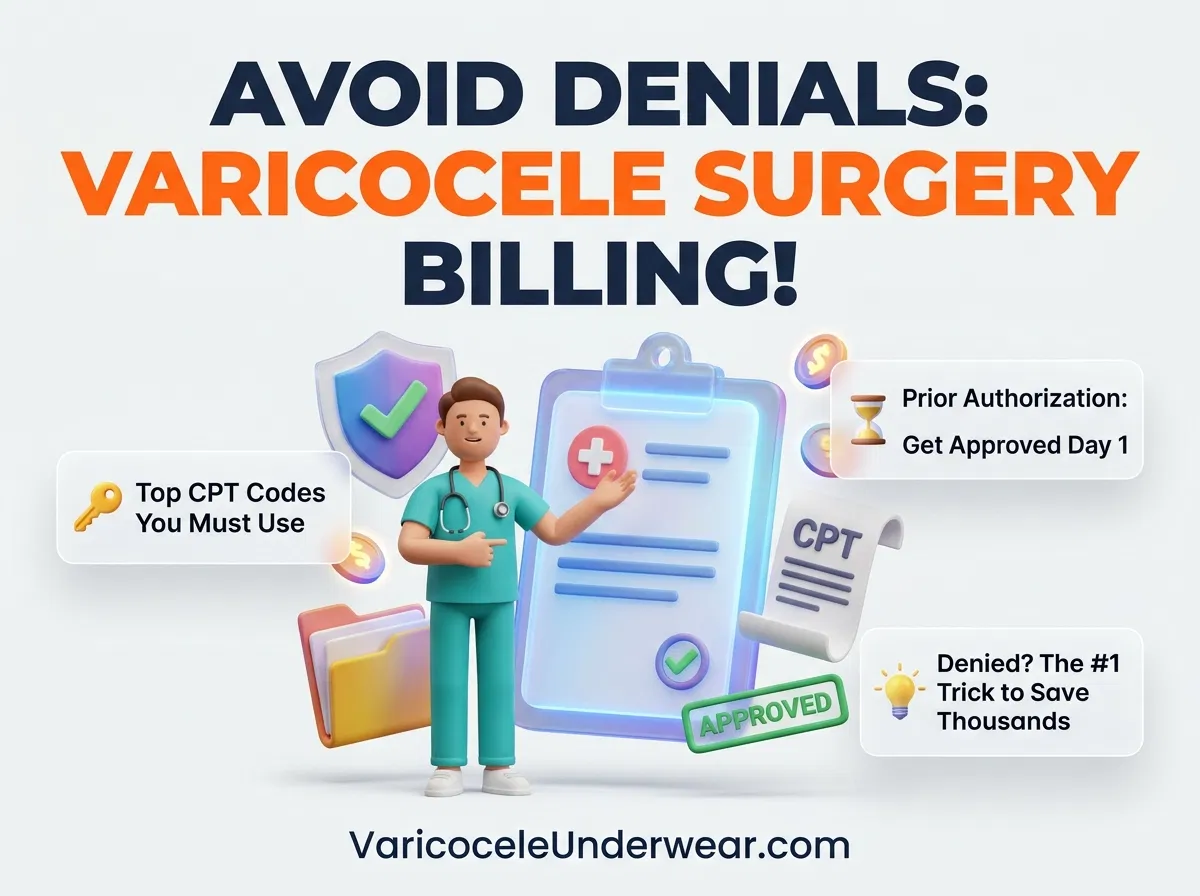
Few experiences in modern healthcare are as exasperating as battling an insurance carrier while dealing with chronic scrotal pain or male factor infertility. You sit in a clinical examination room, listen to your urologist recommend surgical correction for enlarged veins in your scrotum, and assume your health plan will step in to cover the procedure. Instead, you enter an administrative maze of automated denials, missing diagnostic proofs, and peer review demands. Navigating this bureaucratic barrier requires a detailed understanding of this varicocele surgery billing codes CPT guide, because securing insurance approval for vein surgery depends on how accurately your surgical team translates your physical pathology into specific billing numbers and documentation standards.
Understanding Medical Necessity for Insurance Approval
Commercial health insurers and state Medicaid programs do not approve varicocele interventions automatically. To an insurance claims adjuster, an asymptomatic enlarged vein can easily be dismissed as an elective or cosmetic condition unless your clinical chart demonstrates clear medical necessity. The American Urological Association and the European Association of Urology have set clinical criteria that outline exactly when a varicocele warrants intervention. Broadly speaking, coverage hinges on two distinct pathways: severe, intractable pain that resists conservative management, or documented abnormal semen parameters in an adult male attempting conception with a proven female partner. If your clinical chart lacks these exact records, underwriters will issue an immediate pre-service denial.
For pain-related claims, insurance carriers demand a paper trail proving that conservative medical therapy failed to resolve your symptoms over a defined observation window, typically three to six months. This record must show regular physical examinations confirming a palpable, Grade II or Grade III varicocele, supplemented by scrotal color Doppler ultrasound reports showing retrograde venous reflux exceeding two to three millimeters during a Valsalva maneuver. The medical chart must document that oral anti-inflammatory medications, physical activity modification, and scrotal elevation failed to bring lasting relief. When building your clinical defense, reviewing our detailed walk-through on CPT code varicocelectomy billing will show you how medical necessity must align with your doctor’s operative notes.

Discover specialized varicocele underwear designed for daily comfort, support, and recovery — a more targeted option for men who want support without compromise.
Discover the Recommended OptionFor fertility-related claims, the documentation demands are equally rigorous. Insurers require at least two separate, standardized semen analyses collected several weeks apart showing abnormal sperm density, poor motility, or abnormal morphology. Furthermore, coverage guidelines regularly state that the patient’s female partner must have documented normal fertility potential, or treatable fertility factors, because insurers refuse coverage if couple-based conception cannot occur after surgical correction. Without these exact laboratory records, obtaining coverage becomes nearly impossible, frequently leaving patients responsible for unexpected out-of-pocket expenses as outlined in our overview of varicocele surgery cost USA expectations.
Key CPT Codes for Varicocele Procedures
Current Procedural Terminology codes, maintained by the American Urological Association clinical guidelines and the American Medical Association, dictate how hospital facilities and operating surgeons bill for their clinical labor. Using an incorrect or obsolete procedural code guarantees a rejected claim. The most common code utilized for microscopic varicocele repair is CPT 55530, which denotes the excision or high ligation of spermatic veins via an inguinal or subinguinal incision. When a surgical operating microscope is employed to separate tiny testicular lymphatics and internal spermatic arteries from diseased veins, coders frequently report add-on code CPT 69990. However, reimbursement policies differ substantially between commercial carriers regarding whether microscopic guidance is bundled into the primary code or payable as a distinct line item.
Different surgical techniques require alternative billing designations. When an open retroperitoneal or high abdominal approach is chosen to reach the internal spermatic vein higher in the pelvic cavity, the surgical team submits CPT 55535. When a surgeon repairs bilateral or unilateral varicoceles using minimally invasive instruments and a laparoscopic camera through abdominal ports, the operative case must be billed under CPT 55550. For patients who undergo endovascular occlusion through the femoral or internal jugular vein rather than open surgery, interventional radiologists report vascular occlusion code CPT 37241 alongside venous catheterization codes. You can examine specific radiologic coding details inside our complete breakdown on varicocele embolization CPT code processing.

| CPT / HCPCS Code | Clinical Procedure Description | Required Medical Documentation Checklist |
|---|---|---|
| 55530 | Excision of varicocele; inguinal or subinguinal surgical approach | Documented failure of conservative management, scrotal ultrasound with venous reflux, physical exam confirming palpable mass. |
| 55535 | Excision of varicocele; abdominal approach (retroperitoneal / Palomo) | Operative records justifying high retroperitoneal vascular dissection over standard subinguinal access. |
| 55550 | Laparoscopy, surgical, with ligation of spermatic veins | Surgical indications for transabdominal laparoscopic access; documentation of unilateral or bilateral vein clip application. |
| 69990 | Microsurgical techniques using operating microscope (add-on code) | Detailed operative notes stating continuous use of operating microscope for microvascular dissection and arterial preservation. |
| 37241 | Venous vascular embolization or transcatheter occlusion | Venography fluoroscopy records, documentation of venous diameter, coil or sclerosant deployment, selective catheterization codes. |
Mastering the Prior Authorization Process for Varicocelectomy
Achieving successful prior authorization for varicocelectomy operations requires systematic clinical preparation before scheduling an operating room. The surgeon’s administrative billing staff must initiate an authorization request weeks in advance, assembling a comprehensive documentation packet. This packet must contain the formal diagnostic ICD-10 code (typically I86.1 for scrotal varices), clinical progress notes from every consultation, high-resolution ultrasound imaging films with velocity measurements, and detailed histories of pharmacological pain management attempts. Omitting a single page of ultrasound readings can trigger an automated denial that resets the administrative review clock back thirty days.
If an insurer rejects your pre-authorization request, your urologist can request a peer-to-peer review. In this phone conference, your operating surgeon discusses your condition directly with the insurance carrier’s medical medical director. This clinical conversation provides an opportunity to explain the patient’s severe daily limitations, physical testicular atrophy, or progressive loss of semen quality that automated software algorithms routinely overlook. When insurance denial letters cite lack of trial therapies, maintaining meticulous personal records of your failed conservative measures gives your physician the exact dates and evidence necessary to reverse an unfavorable insurance ruling.
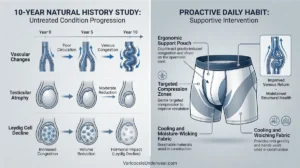
Navigating deductibles, co-insurance, and insurance appeals takes months of patience, leaving you to deal with dull scrotal heaviness while administrative paperwork processes. Many patients find that planning their surgery around their annual deductible reset allows them to minimize personal liability. During this waiting period, relying on certified non-invasive garments like urological support briefs for varicocele pain offers an effective way to relieve testicular tension, improve daily comfort, and counteract gravity without waiting for an insurance approval letter. To see how clinical garments fit alongside standard recovery protocols, examine our detailed clinical guide on the best varicocele underwear options for men managing vein disease.
Ultimately, overcoming insurance obstacles demands persistence, transparency, and collaboration with your clinical care team. Never assume that a procedure code covers every facility fee, anesthesia billing line, or pathology charge associated with your hospital stay. Request a comprehensive billing estimate with every primary and secondary CPT code from your surgeon’s billing office before entering the operating suite. By learning these coding standards and presenting clear documentation from the start, you protect your personal finances while securing the medical care needed to restore your vascular health and long-term comfort.
Related Articles

Choose Varicocele Support Designed for Cooling, Lift, and Daily Comfort
You’ve seen why regular underwear often falls short. Now view the purpose-built option made to reduce heaviness, improve support, and feel comfortable enough for everyday wear.