Receiving an imaging report can feel overwhelming when filled with technical terms like retrograde flow, vein diameter, and maneuver responses. If you experience a heavy, dull ache in your scrotum, your physician likely ordered a color Doppler scan to evaluate your scrotal vascular health. Understanding your varicocele ultrasound reflux measurements helps clarify why blood accumulates in the spermatic cord and how long the backward flow lasts. This guide breaks down what flow numbers mean, how diagnostic grading systems work, and how targeted conservative steps manage daily scrotal pressure.
Decoding Your Scrotal Doppler Report
A color Doppler ultrasound evaluates both blood vessels and fluid flow in real time. Standard grey-scale ultrasound measures physical structures, while color Doppler tracks the movement and direction of red blood cells through the pampiniform plexus, the network of small veins that drain blood from the testicles.
Under normal conditions, tiny one-way valves inside the internal spermatic vein keep blood traveling upward toward the heart against gravity. When these valves fail or weaken, blood flows backward into the scrotum. Radiologists evaluate several specific indicators when [reading Doppler ultrasound results](https://varicoceleunderwear.com/doppler-ultrasound-varicocele-imaging-results-2026/):
- Vein Diameter: Measured in millimeters (mm) while resting and while straining. A resting diameter of 3.0 mm or greater generally indicates abnormal dilation.
- Flow Direction: Normal flow moves toward the abdomen (antegrade). Reverse flow moving back toward the testicle is called retrograde flow.
- Valsalva Response: The patient bears down (as if having a bowel movement) to increase intra-abdominal pressure. This action exposes weak venous valves that might appear stable during quiet breathing.
- Reflux Duration: The exact time, measured in seconds, that blood flows backward during abdominal strain or rest.
To help interpret your scan details, compare your report metrics against these clinical diagnostic benchmarks:
| Doppler Ultrasound Parameter | Standard Diagnostic Cutoff | Clinical Meaning |
|---|---|---|
| Resting Vein Diameter | ≥ 3.0 mm | Dilation and lost vessel wall elasticity in the pampiniform plexus. |
| Transient Reflux Duration | 1.0 to 2.0 Seconds | Brief valve lag during sudden abdominal strain. |
| Pathological Reflux Duration | > 2.0 Seconds | Sustained backflow confirming significant venous insufficiency. |
| Spontaneous Continuous Reflux | Present at Rest | Complete valve failure with continuous pooling without straining. |
| Peak Retrograde Velocity | > 30 to 38 cm/s | High-velocity reverse blood surge toward the testicular tissue. |
What Retrograde Flow and Varicocele Ultrasound Reflux Time Indicate
The time duration of reverse blood flow is one of the most informative measurements on your ultrasound report. Reflux time measures how many seconds blood travels backward before stopping or whether it continues flowing in reverse indefinitely. Medical consensus published in [peer-reviewed imaging guidelines](https://www.ncbi.nlm.nih.gov/pmc/articles/PMC7893963/) establishes a reflux cutoff of two seconds during the Valsalva maneuver as the hallmark of clinically significant venous incompetence.

Discover specialized varicocele underwear designed for daily comfort, support, and recovery — a more targeted option for men who want support without compromise.
Discover the Recommended OptionHere is how clinicians interpret specific reflux timeframes:
- Under 1 Second: Considered physiological flow or minor valve delay. Blood briefly hesitates before resuming upward motion.
- 1 to 2 Seconds: Indicates mild or intermittent valve weakness, often seen in early-stage or low-grade cases.
- Over 2 Seconds: Confirms established varicocele ultrasound reflux. The internal spermatic valves remain open under strain, allowing blood to pool directly around the testicle.
- Continuous Flow at Rest: Blood drains backward even without abdominal pressure, showing complete loss of valve integrity.
Radiologists and urologists combine reflux timing with physical location to establish a standardized [varicocele grading scale](https://varicoceleunderwear.com/varicocele-grade-1-2-3-severity-treatment/). Many centers use the Sarteschi Doppler grading system to classify severity:
- Sarteschi Grade 1: Reflux occurs only in the groin canal during the Valsalva maneuver; no testicular backflow.
- Sarteschi Grade 2: Reflux reaches the top of the testicle during the Valsalva maneuver only.
- Sarteschi Grade 3: Reflux reaches the bottom of the testicle during the Valsalva maneuver.
- Sarteschi Grade 4: Reflux occurs spontaneously at rest and increases during the Valsalva maneuver.
- Sarteschi Grade 5: Spontaneous reflux occurs at rest without increasing during abdominal strain.
How Gravitational Elevation Reduces Reflux
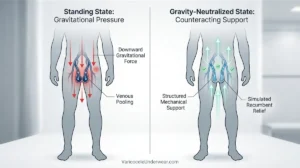
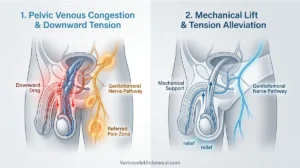
Blood accumulation in dilated veins creates mechanical drag, elevated scrotal temperature, and a deep, aching discomfort that worsens after long hours of standing or sitting. Gravity continuously pulls down on the fluid column inside the spermatic veins. When you stand upright, the vertical height between your scrotum and abdomen creates hydrostatic pressure that accelerates retrograde blood flow through incompetent valves.
Understanding [scrotal support physics](https://varicoceleunderwear.com/physics-scrotal-support-varicocele-pressure/) highlights why physical positioning makes a noticeable difference in comfort. Elevating the scrotum closer to the groin shortening the vertical path that blood must travel against gravity reduces hydrostatic load on congested vessels. Scrotal elevation works by:
- Decreasing the vertical fluid column pressure in the pampiniform plexus.
- Preventing excessive vein stretching during physical activity or prolonged standing.
- Encouraging passive, upward venous return toward the systemic circulation.
- Relieving strain on the cremaster muscle and surrounding spermatic tissues.
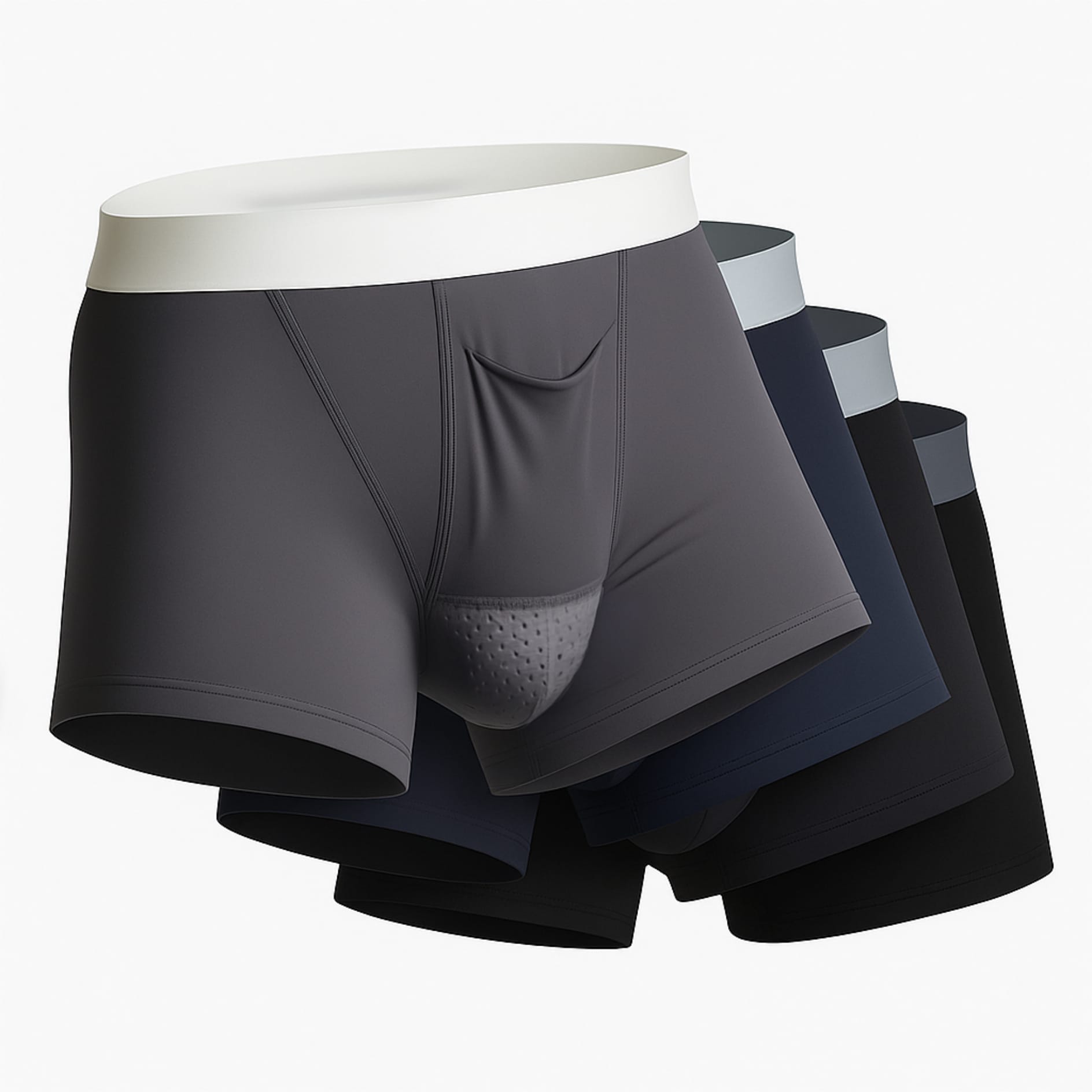
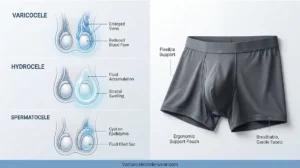
For daily management during work, exercise, or long travel, using structured support like [Varicocele Support Underwear](https://varicoceleunderwear.com/product/varicocele-underwear-support-cooling/) provides targeted anatomical suspension. Elevating the scrotum shortens the retrograde path of blood, helping to neutralize gravity-driven reflux and promote normal, upward circulatory flow. While non-invasive support garments do not fix structurally damaged vein valves or eliminate an underlying varicocele, physical elevation serves as an accessible option for [reducing varicocele symptoms naturally](https://varicoceleunderwear.com/how-to-reduce-varicocele-symptoms-without-surgery/) alongside professional medical advice.
Clinical management frameworks published in [clinical urology research](https://pubmed.ncbi.nlm.nih.gov/22450604/) emphasize conservative lifestyle adjustments, scrotal suspension, and routine monitoring as appropriate first-line steps when surgery or embolization is not immediately required.
Frequently Asked Questions
What is a normal reflux time on a scrotal Doppler ultrasound?
A normal result shows zero retrograde blood flow or a brief delay lasting less than one second during the Valsalva maneuver. Reflux lasting longer than two seconds under strain is considered diagnostic for a varicocele.
Does a longer ultrasound reflux time mean I need surgery?
Not necessarily. Surgical intervention depends on clinical symptoms, persistent scrotal pain, testicular atrophy, or abnormal semen analysis results. A long reflux time alone without pain or fertility issues is often managed with monitoring and conservative support.
Can supportive underwear permanently fix broken spermatic vein valves?
No garment can repair damaged venous valves or cure a varicocele. Anatomical support elevates the scrotum to neutralize gravity, shorten the retrograde flow path, and relieve daily ache, managing discomfort without altering internal vein anatomy.
Key Takeaway
Your Doppler ultrasound report offers a detailed blueprint of your scrotal blood flow, where a reflux time over two seconds signals valve incompetence in the spermatic veins. While supportive garments cannot repair damaged internal valves, physically elevating the scrotum reduces hydrostatic pressure, shortens the retrograde path of blood, and eases daily discomfort. Review your report details with a qualified urologist to determine whether conservative management or further medical evaluation best fits your needs.
Related Articles
Choose Varicocele Support Designed for Cooling, Lift, and Daily Comfort
You’ve seen why regular underwear often falls short. Now view the purpose-built option made to reduce heaviness, improve support, and feel comfortable enough for everyday wear.