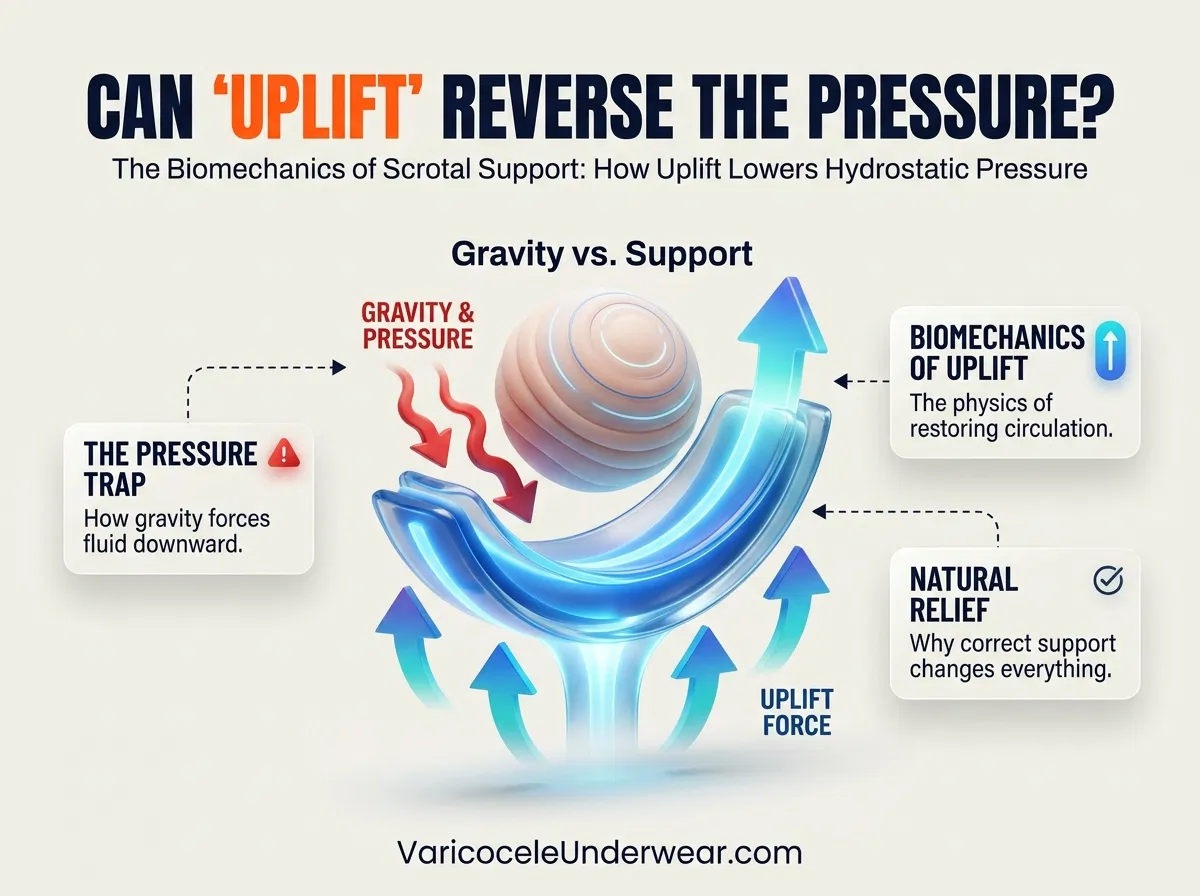
Gravity creates a vertical hydrostatic pressure gradient inside the spermatic veins when a man stands upright. Hydrostatic pressure is the force generated by the weight of fluid above a specific point. In a simplified, continuous column of blood, the relationship is expressed as ΔP = ρgΔh, where blood density, gravitational acceleration, and vertical height determine the pressure difference. The lower the point, the greater the gravitational component of pressure. Raising the scrotum moves the dependent veins upward relative to gravity, theoretically shortening the vertical fluid column and reducing its gravitational pressure component. This is the physical principle behind the biomechanics of scrotal support and the idea that upward suspension reduces varicocele pressure. However, theoretical pressure changes must be separated from proven clinical outcomes. Spermatic veins are living, branching vessels with blood flow, valves, and variable anatomy. External support can change scrotal position and movement, but its effect on measured venous pressure and reflux has not been established in controlled clinical trials.
The Biomechanics of Scrotal Hydrostatic Pressure
A varicocele develops when veins in the pampiniform plexus, the network surrounding each testicle, become enlarged. These veins carry blood away from the testicles toward larger abdominal veins. Normally, one-way venous valves help prevent backward blood flow. When these valves fail or the surrounding venous anatomy creates abnormal pressure gradients, blood can reflux, meaning it moves backward instead of returning efficiently toward the heart. Gravity contributes to the pressure experienced by these dependent veins during standing. The left testicular vein normally drains into the left renal vein, while the right generally drains directly into the inferior vena cava. These different drainage pathways help explain the greater frequency of left-sided varicoceles. A peer-reviewed review identifies valve dysfunction, collateral venous pathways, and compression of the left renal vein as possible contributing mechanisms. For additional background, see this explanation of the physics of scrotal support and varicocele pressure. The important distinction is that gravity contributes to venous pressure, but it is not the only factor controlling blood flow.

Discover specialized varicocele underwear designed for daily comfort, support, and recovery — a more targeted option for men who want support without compromise.
Discover the Recommended OptionThe physics of vein pressure relief can be illustrated using the hydrostatic equation: ΔP = ρgΔh. Blood has an approximate density of 1,060 kilograms per cubic meter, while gravitational acceleration is approximately 9.81 meters per second squared. With these values, a one-centimeter reduction in vertical fluid height corresponds to approximately 104 pascals, or 0.78 millimeters of mercury, in an idealized model. A hypothetical three-centimeter elevation would therefore change the gravitational component by approximately 2.3 millimeters of mercury at the point being measured. This mathematical relationship explains why moving a dependent point upward changes its hydrostatic pressure component. However, it does not establish that a support garment produces a three-centimeter lift or achieves the same reduction in actual spermatic vein pressure. Real veins are flexible, branching structures with active blood flow, variable resistance, and changing pressure at their upper connections. The calculation is useful for understanding gravity, not for predicting an individual patient’s Doppler measurements or fertility outcomes.
Vector Forces and Upward Suspension Physics
Scrotal suspension also involves mechanical force vectors. A vector is a force with both magnitude and direction. During standing, the weight of the testicular contents acts downward through gravity. Without sufficient support, the scrotal tissues remain in a dependent position, allowing movement and some mechanical traction on surrounding structures. A supportive garment supplies an upward reaction force through its fabric and anatomical pouch. This force opposes part of the downward load and helps stabilize the scrotum. In a simplified static force diagram, the vertical forces approach equilibrium when the upward support force balances the downward weight and other supporting tissue forces. This principle is consistent with basic engineering statics, which describes how opposing forces maintain the position of an object. The relationship is explained in the open textbook Engineering Statics and its principles of vector forces and equilibrium. However, balancing external mechanical forces is not the same as directly lowering pressure inside a blood vessel. The distinction matters when discussing the possible benefits of supportive underwear.
| Mechanical factor | Force direction | Expected physical effect | Clinical interpretation |
|---|---|---|---|
| Gravitational drag | Downward | Encourages dependent positioning of scrotal contents. | Contributes to the gravitational pressure gradient. |
| Suspension force | Upward | Supports tissue weight and reduces excessive movement. | May improve comfort and reduce traction. |
| Lateral containment | Inward and sideways | Limits unnecessary movement and friction. | Should not create painful compression. |
| Venous pressure gradient | Along the venous drainage pathway | Depends on gravity, blood flow, valve function, and venous anatomy. | Cannot be determined from garment support alone. |
The relationship between gravitational drag and suspension force becomes particularly relevant during prolonged standing, walking, and physical activity. Every movement changes the forces acting on the scrotal tissues. Unsupported movement can produce repeated shifting, friction against the thighs, and tension around the spermatic cord. The spermatic cord is the structure containing the blood vessels, nerves, and vas deferens connecting the testicle to the body. An anatomical support pouch can distribute the external load over a wider area rather than allowing the entire weight to hang from a small region of tissue. This can improve mechanical stability and reduce the sensation of heaviness for some men. However, greater compression is not automatically better. Concentrated pressure around the upper scrotum or groin may cause discomfort and should be avoided. The objective of a well-designed support garment is comfortable positioning, not squeezing the veins or forcing blood through them. Understanding this distinction helps explain why suspension and compression are not interchangeable mechanical approaches.
How Anatomical Lift Reduces Vein Strain
Anatomical lift changes the position of the scrotum relative to the surrounding body structures. When a supportive pouch gently raises the testicles, it can reduce excessive downward movement and the mechanical traction associated with unsupported hanging. This is particularly relevant for men who experience a dull ache, dragging sensation, or discomfort after several hours of standing. A correctly fitted garment can also reduce friction between the scrotum and inner thighs during walking or exercise. These effects describe mechanical support and symptom management, not a proven reduction in internal venous wall stress. For practical garment selection, the guide to choosing the best underwear for varicocele discusses pouch structure, fit, and fabric. A separate comparison of varicocele underwear options provides additional design information. The most appropriate garment should hold the testicles comfortably without creating painful pressure, restricting movement, or producing skin irritation. Persistent discomfort should never be managed by simply choosing increasingly tight underwear.
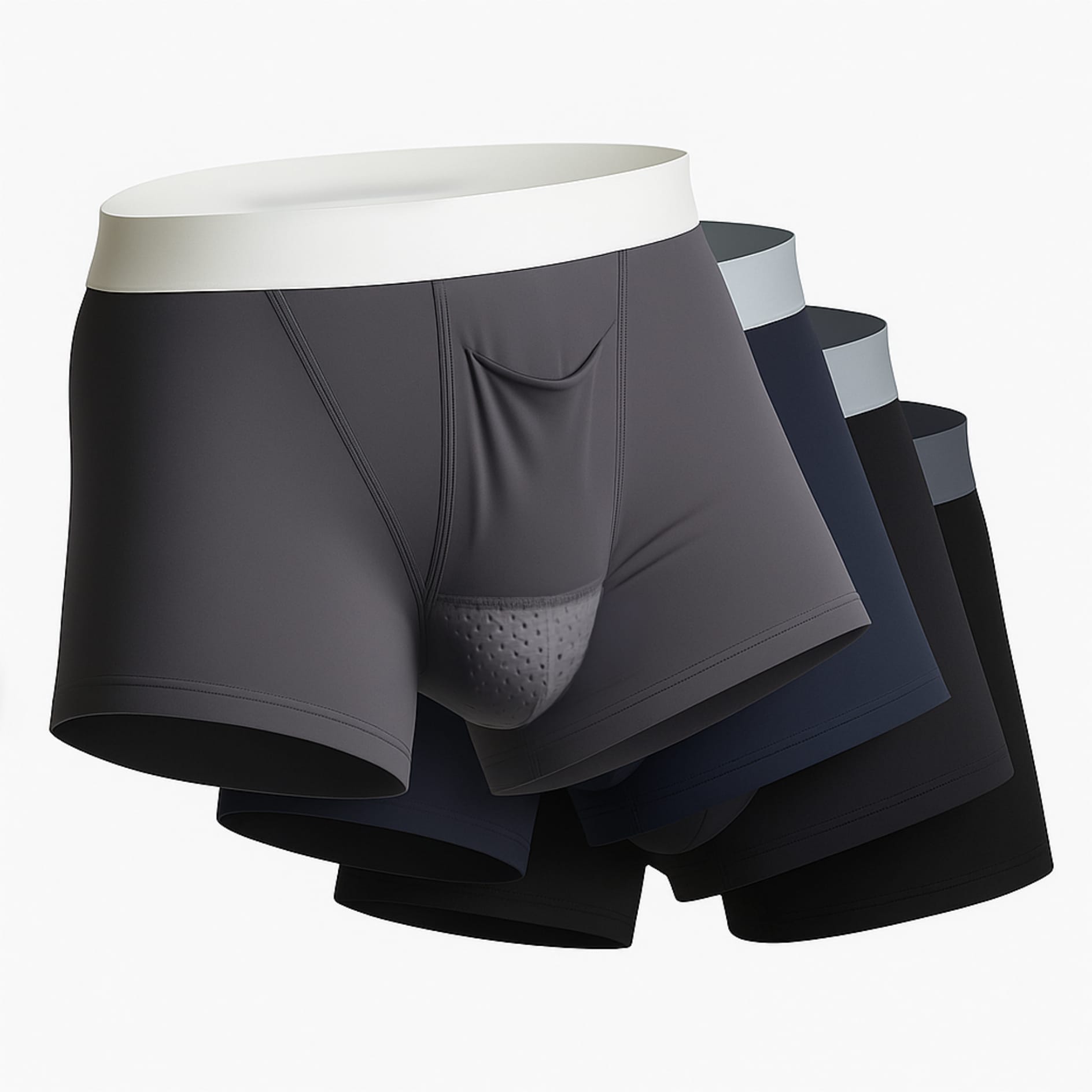
VaricoceleUnderwear.com provides a commercial example of biomechanical scrotal uplift underwear, marketed with an anatomical support design and cooling features. Its design illustrates how an independent pouch can provide upward support while separating the scrotum from surrounding fabric. This is an ergonomic example of applying basic suspension principles to clothing, not proof that the product lowers measured spermatic vein pressure or reverses venous reflux. No AUA or EAU guideline establishes a specific underwear lift height as a treatment standard. Clinical management remains based on symptoms, physical examination, and appropriate testing. The European Association of Urology guidelines recommend physical examination for diagnosis and Doppler ultrasound when examination findings are unclear. The AUA/ASRM male infertility guideline, amended in 2024, recommends considering surgical repair for men attempting conception who have a palpable varicocele, infertility, and abnormal semen parameters, with specific exceptions. A varicocele does not automatically mean infertility, and underwear cannot replace a fertility assessment. Men experiencing persistent pain or fertility concerns should discuss examination and semen analysis with a urologist. For additional conservative care, see these non-surgical approaches to managing varicocele symptoms.
Related Articles

Choose Varicocele Support Designed for Cooling, Lift, and Daily Comfort
You’ve seen why regular underwear often falls short. Now view the purpose-built option made to reduce heaviness, improve support, and feel comfortable enough for everyday wear.