If you’ve been diagnosed with a varicocele, you’re facing an important decision. Should you opt for traditional surgery or the newer embolization procedure? Which one gets you back to normal life faster?
These swollen veins in the scrotum affect roughly 15% of adult males, and many experience pain, discomfort, or fertility concerns. The good news is that both treatment options have high success rates. But they differ significantly in recovery time, invasiveness, and overall experience.
This guide breaks down everything you need to know about varicocele embolization versus surgery in 2026. You’ll learn which procedure offers faster recovery, how success rates compare, and what factors should guide your decision. For a complete overview of all treatment approaches, see our comprehensive varicocele treatment guide.
What Is Varicocele Embolization?
Varicocele embolization is a minimally invasive procedure performed by an interventional radiologist. Instead of surgical incisions, the doctor accesses the affected veins through a small catheter, typically inserted in the groin or neck.
How it works:
- A tiny catheter is guided to the varicocele using real-time X-ray imaging
- Small coils or a special solution block blood flow to the enlarged veins
- Blood naturally reroutes through healthy vessels
- The procedure takes 45 minutes to 2 hours
No general anesthesia is required. Most patients receive only local anesthesia and mild sedation.
What Is Varicocele Surgery?
Surgical repair, called varicocelectomy, involves physically cutting and tying off the affected veins. Several surgical approaches exist:
| Surgery Type | Incision Location | Anesthesia | Hospital Stay |
|---|---|---|---|
| Microsurgical (Subinguinal) | Lower groin | General/Regional | Outpatient |
| Inguinal | Groin crease | General | Outpatient |
| Laparoscopic | 3 small abdominal ports | General | Outpatient |
| Open Retroperitoneal | Flank/abdomen | General | Outpatient |
Microsurgical varicocelectomy is currently considered the gold standard for surgical treatment due to its precision and lower complication rates.
Which Treatment Has the Fastest Recovery Time?
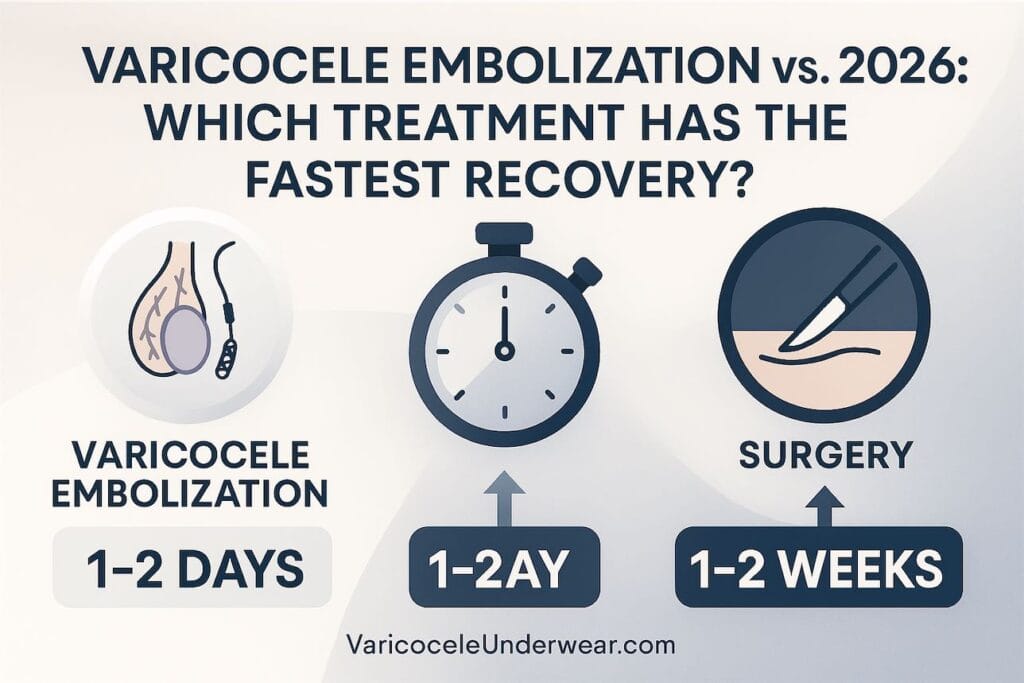
Embolization wins for speed of recovery.
Here’s what the data shows:
| Recovery Milestone | Embolization | Microsurgery | Laparoscopic |
|---|---|---|---|
| Return to desk work | 1-2 days | 3-7 days | 5-7 days |
| Light physical activity | 3-5 days | 7-10 days | 7-14 days |
| Full exercise/sports | 7-10 days | 2-4 weeks | 2-3 weeks |
| Sexual activity | 5-7 days | 2-3 weeks | 2-3 weeks |
| Complete healing | 1-2 weeks | 4-6 weeks | 3-4 weeks |
A 2023 systematic review published in the Journal of Vascular and Interventional Radiology confirmed that embolization patients return to normal activities significantly faster than surgical patients.
Real Patient Experience
“I had embolization on a Thursday morning and was back at my office job Monday. My colleague had microsurgery for the same condition and needed two weeks off.” – Mark, 34, software developer
How Do Success Rates Compare in 2026?
Both procedures show excellent outcomes, though definitions of “success” vary across studies.
Technical Success Rates
| Procedure | Technical Success | Varicocele Recurrence |
|---|---|---|
| Microsurgical varicocelectomy | 95-99% | 1-2% |
| Laparoscopic surgery | 90-95% | 3-7% |
| Embolization | 85-95% | 5-11% |
Fertility Improvement Rates
For men seeking treatment due to infertility, both options improve sperm parameters:
- Sperm concentration improvement: 50-70% of patients (both methods)
- Pregnancy rates post-treatment: 30-50% within 12 months
- Time to see improvement: 3-6 months for sperm production changes
Research from the American Urological Association indicates that microsurgery may have a slight edge for fertility outcomes, though the difference is modest.
Pain and Discomfort: What to Expect
During the Procedure
Embolization: Minimal discomfort. You may feel warmth or mild pressure when contrast dye is injected. Most patients describe it as “unusual but not painful.”
Surgery: You won’t feel anything under anesthesia. Post-operative pain is more significant.
After the Procedure
| Pain Level | Embolization | Surgery |
|---|---|---|
| Day 1 | Mild soreness at catheter site | Moderate surgical site pain |
| Days 2-3 | Minimal; OTC pain relief sufficient | Prescription pain medication often needed |
| Week 1 | Usually pain-free | Gradual improvement |
| Week 2+ | Fully resolved | Most pain resolved |
Pro tip: During recovery from either procedure, supportive underwear can reduce scrotal discomfort and swelling. Specialized varicocele support underwear with cooling technology provides gentle compression that many men find helpful during the healing process.
Risks and Complications: Honest Comparison
No procedure is risk-free. Here’s what you should know:
Embolization Risks
- Coil migration (rare, <1%)
- Allergic reaction to contrast dye
- Bruising at catheter insertion site
- Technical failure requiring repeat procedure (5-10%)
- Radiation exposure (minimal, equivalent to a few X-rays)
Surgery Risks
- Hydrocele formation (fluid around testicle): 5-10%
- Testicular artery injury: <1% with microsurgery
- Wound infection: 1-2%
- Chronic pain: 1-2%
- Recurrence requiring additional treatment: 1-7%
According to Mayo Clinic guidelines, microsurgical technique has the lowest complication rate among surgical options.
Cost Comparison: Embolization vs. Surgery in 2026
Healthcare costs vary significantly by location, insurance, and facility. These are approximate U.S. averages:
| Cost Factor | Embolization | Microsurgery | Laparoscopic |
|---|---|---|---|
| Procedure cost | $5,000-$11,000 | $7,000-$15,000 | $8,000-$18,000 |
| Anesthesia | Included | $500-$1,500 | $800-$2,000 |
| Facility fee | Included | $2,000-$5,000 | $3,000-$7,000 |
| Lost work income | 1-2 days | 1-2 weeks | 1-2 weeks |
Insurance coverage: Most plans cover both procedures when medically indicated. Embolization may require prior authorization since it’s classified as interventional radiology rather than surgery.
Who Should Choose Embolization?
Embolization may be the better choice if you:
- Need the fastest possible recovery
- Want to avoid general anesthesia
- Have had previous groin surgery
- Prefer a needle puncture over an incision
- Have bilateral (both sides) varicoceles
- Are concerned about surgical risks
Who Should Choose Surgery?
Microsurgical varicocelectomy may be preferable if you:
- Want the lowest possible recurrence rate
- Are primarily treating infertility
- Have anatomical factors that make embolization difficult
- Failed previous embolization
- Prefer a single definitive procedure
What Urologists Recommend in 2026
“Both embolization and microsurgery are excellent options. The choice often comes down to patient preference, recovery needs, and local expertise. For my patients who prioritize fast recovery and minimal invasiveness, I discuss embolization. For those focused primarily on fertility optimization, microsurgery remains my first recommendation.”
Dr. James Chen, Reproductive Urologist, 18 years clinical experience
Decision-Making Flowchart
Primary concern is fast recovery?
→ Consider embolization first
Primary concern is fertility?
→ Microsurgery has slight edge in some studies
Had previous groin surgery?
→ Embolization avoids scar tissue complications
Bilateral varicoceles?
→ Embolization can treat both sides in one session
Need lowest recurrence rate?
→ Microsurgery by experienced surgeon
Frequently Asked Questions
Can varicocele come back after embolization or surgery?
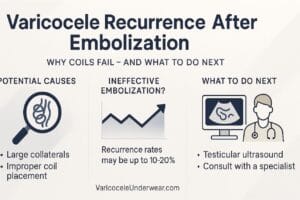
Yes, recurrence is possible with both treatments. Embolization has a recurrence rate of 5-11%, while microsurgery has the lowest rate at 1-2%. If a varicocele returns, the alternative procedure can typically be performed. Many urologists consider microsurgery the preferred option after failed embolization.
Is varicocele embolization covered by insurance?
Most health insurance plans cover embolization when performed for documented symptoms or fertility concerns. Coverage is similar to surgical options. Contact your insurer before scheduling and request pre-authorization. Some plans classify embolization differently than surgery, which may affect your out-of-pocket costs.
How long after treatment will sperm quality improve?
Sperm production takes approximately 72 days per cycle. Most fertility specialists recommend waiting 3-6 months after either embolization or surgery before repeating semen analysis. Improvement rates are similar between procedures, with 50-70% of men showing better sperm parameters by the 6-month mark.
Key Takeaways
If speed of recovery is your priority: Embolization offers the fastest return to normal activities, typically 1-2 days for desk work and 7-10 days for full activity.
If lowest recurrence matters most: Microsurgical varicocelectomy has the best long-term durability at 98-99% success.
Both options work: Success rates for symptom relief and fertility improvement are comparable. Your choice should factor in your lifestyle, work demands, and personal preferences.
Talk with both a urologist and an interventional radiologist if possible. Getting perspectives from specialists who perform each procedure helps you make the most informed decision.
Have questions about your varicocele treatment options? Share your experience or concerns in the comments below. For personalized medical advice, consult a qualified urologist or interventional radiologist in your area.