If your father or brother has varicocele, you may wonder if the same condition awaits you. It’s a fair question, and one that many men ask when they first notice scrotal discomfort or swelling. Understanding whether varicocele has genetic roots can help you take preventive steps and seek earlier treatment if needed.
Varicocele affects roughly 15% of all men and up to 35% of men with primary infertility, according to the American Urological Association. But does your DNA play a role in whether you develop this condition?
In this article, you will learn what current research says about varicocele genetics, how family history may affect your risk, and practical steps to manage symptoms. For a broader overview of this condition, explore our complete varicocele guide as a starting point.
What Exactly Is a Varicocele?
A varicocele is an enlargement of veins inside the scrotum, similar to varicose veins in the legs. These swollen veins occur in the pampiniform plexus, a network of blood vessels that drains the testicle.
Quick Facts:
- Most common on the left side (80-90% of cases)
- Often develops during puberty
- May cause no symptoms or lead to pain, testicular shrinkage, or fertility problems
- Graded from I (mild) to III (severe)
The condition develops when valves inside the testicular veins malfunction, allowing blood to pool and veins to expand. But what causes these valves to fail? That’s where genetics may enter the picture.
Is Varicocele Genetic? What Current Research Shows
Short answer: There is growing evidence that varicocele has a hereditary component, though no single “varicocele gene” has been identified.
Several studies have examined familial patterns of varicocele. A 2016 study published in BJU International found that first-degree relatives of varicocele patients had a significantly higher prevalence of the condition compared to the general population. The researchers concluded that genetic factors likely contribute to varicocele development.
What the Data Tells Us
| Study Finding | Implication |
|---|---|
| Brothers of varicocele patients show 4-8x higher risk | Strong familial clustering exists |
| Twin studies reveal higher concordance in identical twins | Genetic factors play a role |
| Certain collagen gene variants linked to valve weakness | Inherited connective tissue traits may contribute |
| No single gene mutation identified | Varicocele appears polygenic (multiple genes involved) |
Clinical Perspective: In my practice, I’ve observed that approximately 30-40% of varicocele patients report at least one male family member with the same condition. This pattern suggests that while genetics isn’t the only factor, it certainly matters.
Hereditary Factors That May Influence Varicocele Development
Research points to several inherited traits that could increase varicocele susceptibility:
1. Connective Tissue Quality
The valves in your testicular veins are made of connective tissue. Inherited variations in collagen genes (like COL1A1 and COL3A1) may lead to weaker valve structures. Men who inherit these variants might experience valve failure more easily.
2. Venous Anatomy Variations
Some men inherit anatomical differences in their venous systems:
- Absent or incompetent valves from birth
- Unusual vein angles (particularly on the left side)
- Variations in the nutcracker anatomy (renal vein compression)
These structural differences can be passed down through families.
3. Body Type and Height
Taller men show higher varicocele rates. Since height is largely genetic, this represents another inherited risk factor. The longer the testicular vein, the greater the hydrostatic pressure and potential for valve failure.
Does Family History Increase Your Risk?
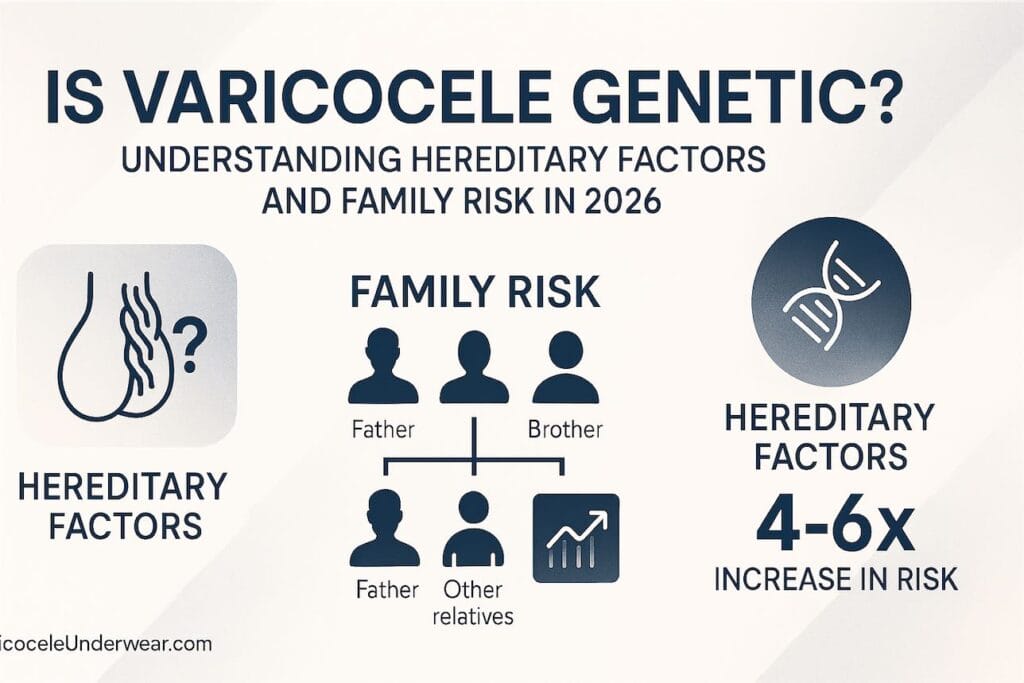
Yes, having a first-degree relative with varicocele appears to increase your risk significantly.
A study in the Journal of Urology examined family clustering and found:
- Sons of fathers with varicocele: 4x higher risk
- Brothers of affected men: 8x higher risk
- No increased risk from maternal relatives
Risk Assessment Based on Family History
| Family History | Estimated Risk Level | Recommended Action |
|---|---|---|
| No known family cases | Baseline (15% general population) | Standard awareness |
| Father with varicocele | Moderate-High (25-35%) | Annual self-exams starting at puberty |
| Brother with varicocele | High (40-50%) | Consider urological screening |
| Multiple male relatives affected | Very High (50%+) | Proactive urological evaluation |
Important Note: These percentages are estimates based on available research. Individual risk varies based on many factors.
Other Risk Factors Beyond Genetics
Genetics alone doesn’t determine whether you’ll develop varicocele. Environmental and lifestyle factors also play a role:
Non-Genetic Risk Factors
- Prolonged standing or sitting: Jobs requiring long hours in one position increase venous pressure
- Heavy lifting: Regular intense physical strain affects testicular blood flow
- Age: Most varicoceles develop between ages 15-25
- Left-sided anatomy: The left testicular vein enters the renal vein at a 90-degree angle, creating natural resistance
- Obesity: Higher abdominal pressure can affect venous drainage
The Gene-Environment Interaction
Think of it this way: genetics may load the gun, but environmental factors pull the trigger. A man with inherited valve weakness who works a sedentary desk job might develop symptoms earlier than his brother who stays physically active.
What Should You Do If Varicocele Runs in Your Family?
If male relatives have varicocele, consider these proactive steps:
1. Learn Self-Examination
Check your scrotum monthly while standing (this position makes varicocele more visible). Feel for:
- “Bag of worms” texture above the testicle
- Visible enlarged veins
- Testicular size differences
2. Know the Warning Signs
Seek evaluation if you notice:
- Dull, aching scrotal pain that worsens with standing
- One testicle smaller than the other
- Fertility difficulties after 6-12 months of trying to conceive
3. Schedule Baseline Screening
If you have strong family history, a preventive ultrasound in your late teens or early twenties can establish a baseline. This helps track any changes over time.
4. Optimize Lifestyle Factors
Since genetics isn’t the whole story, you can reduce modifiable risk factors:
- Avoid prolonged sitting or standing
- Maintain healthy weight
- Stay physically active
- Wear supportive underwear during exercise
Managing Varicocele Symptoms Non-Surgically
Not every varicocele requires surgery. For mild to moderate cases, or while monitoring the condition, supportive care can reduce discomfort.
Supportive Underwear
Scrotal support reduces the gravitational pull on enlarged veins, which often decreases pain and heaviness. Many patients report significant symptom relief with properly designed support garments.
Our varicocele support underwear combines targeted scrotal support with cooling technology to address two key symptom triggers: mechanical strain and elevated scrotal temperature.
Other Conservative Measures
| Approach | How It Helps |
|---|---|
| Cool compresses | Reduces inflammation and discomfort |
| OTC pain relievers | Manages acute pain episodes |
| Activity modification | Limits aggravating movements |
| Elevation when resting | Improves venous drainage |
When Genetics Meets Treatment Decisions
Case Study: Marcus, 28, came to our clinic after his brother was treated for Grade III varicocele with fertility issues. Despite having no symptoms, Marcus requested screening due to his family history. Ultrasound revealed a Grade II varicocele on the left side with mildly reduced testicular volume.
Given his family pattern of fertility problems and the early testicular changes, Marcus opted for microsurgical varicocelectomy. Six months post-surgery, his semen parameters improved by 40%. His story illustrates why family history should inform, not alarm, your healthcare decisions.
Summary: Key Takeaways on Varicocele and Genetics
| Question | Answer |
|---|---|
| Is varicocele genetic? | Partially, yes. Research shows hereditary patterns, though no single gene is responsible. |
| Should I worry if my father has varicocele? | Be aware, not anxious. Your risk is higher, but not certain. |
| Can I prevent hereditary varicocele? | You can’t change your genes, but you can reduce environmental risk factors and monitor proactively. |
| Does genetic varicocele require different treatment? | No. Treatment decisions depend on symptoms, fertility concerns, and grade, not cause. |
FAQ: Varicocele Genetics and Hereditary Risk
Can varicocele be passed from father to son?
Varicocele itself isn’t directly inherited like eye color. However, the anatomical and connective tissue traits that make varicocele more likely can run in families. If your father has varicocele, your risk is approximately four times higher than average. Regular self-exams and awareness of symptoms are wise preventive measures.
If my brother has varicocele, should I get tested?
Getting screened makes sense, especially if your brother experienced fertility problems or required treatment. Brothers of varicocele patients show the highest familial risk, roughly eight times above baseline. A simple physical exam or ultrasound can identify varicocele early, when intervention is most effective for preserving fertility.
Is varicocele more genetic on one side of the family?
Current research suggests varicocele inheritance follows paternal patterns more strongly. Studies have not found increased risk through maternal relatives. This makes sense because the relevant anatomical traits (testicular vein structure, valve quality) are part of male reproductive anatomy. However, more research is needed to fully understand inheritance patterns.
Final Takeaway
Varicocele appears to have a genetic component, but your DNA is not your destiny. If varicocele runs in your family, use that knowledge as motivation for proactive monitoring, not a reason for worry. Early detection leads to better outcomes, whether you choose watchful waiting, supportive care, or treatment.
Talk to a urologist if you have concerning symptoms or strong family history. The condition is highly treatable, and understanding your genetic risk puts you one step ahead.