You need scrotal support for your varicocele, and you’re trying to decide between varicocele-specific underwear and a traditional jockstrap. Both provide suspension. Both are marketed for scrotal support. But they are fundamentally different products designed for different purposes, and for daily varicocele management, the differences matter both for symptom relief and for the health of the very tissue you’re trying to protect. This guide compares both options across every relevant dimension: suspension quality, thermal impact, comfort for extended wear, evidence base, and what medical-grade suspension actually means in practice.
What Medical-Grade Scrotal Suspension Actually Means
The term “medical-grade” in the context of scrotal support refers to three specific functional requirements: consistent upward lift of the scrotum against gravity, even distributed pressure that doesn’t create localized compression points, and maintenance of these properties throughout a full day of activity including sitting, standing, and movement. The goal is to reduce the hydrostatic venous pressure in the pampiniform plexus that worsens with gravitational descent of the scrotum.
A varicocele sits in dilated veins that are made worse by the weight of the scrotum hanging freely. Every centimeter of scrotal descent increases hydrostatic venous pressure. Upward suspension that keeps the scrotum close to the body reduces this pressure gradient, decreases venous pooling, and provides measurable symptomatic relief. This is the core physics of scrotal support for varicocele, regardless of which specific garment delivers it.
Jockstraps: What They Do and Don’t Do
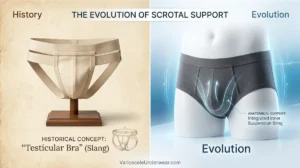
The athletic supporter (jockstrap) was designed in the late 19th century for bicycle riders and provides firm scrotal suspension through a rigid elastic pouch and waistband system. For short-duration athletic activity, it provides adequate mechanical support that prevents scrotal movement during running, cycling, or contact sports. This was its original and remains its primary function.
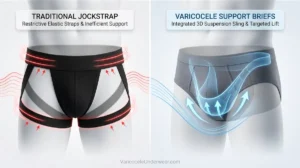
For daily varicocele management, jockstraps have significant limitations. The hard elastic waistband and leg straps create localized pressure points that become uncomfortable within hours of continuous wear. The open-back design provides no insulation from ambient temperature but also no active cooling. The rigid pouch architecture doesn’t adapt to body position changes (sitting vs. standing), meaning the suspension characteristics change significantly throughout the day. The lack of leg coverage means the inguinal area, where the spermatic cord runs, gets no positional support. Most critically, jockstraps are designed for protection from impact, not for optimizing venous hemodynamics in dilated scrotal veins.

Discover specialized varicocele underwear designed for daily comfort, support, and recovery — a more targeted option for men who want support without compromise.
Discover the Recommended OptionVaricocele-Specific Underwear: Design Differences That Matter
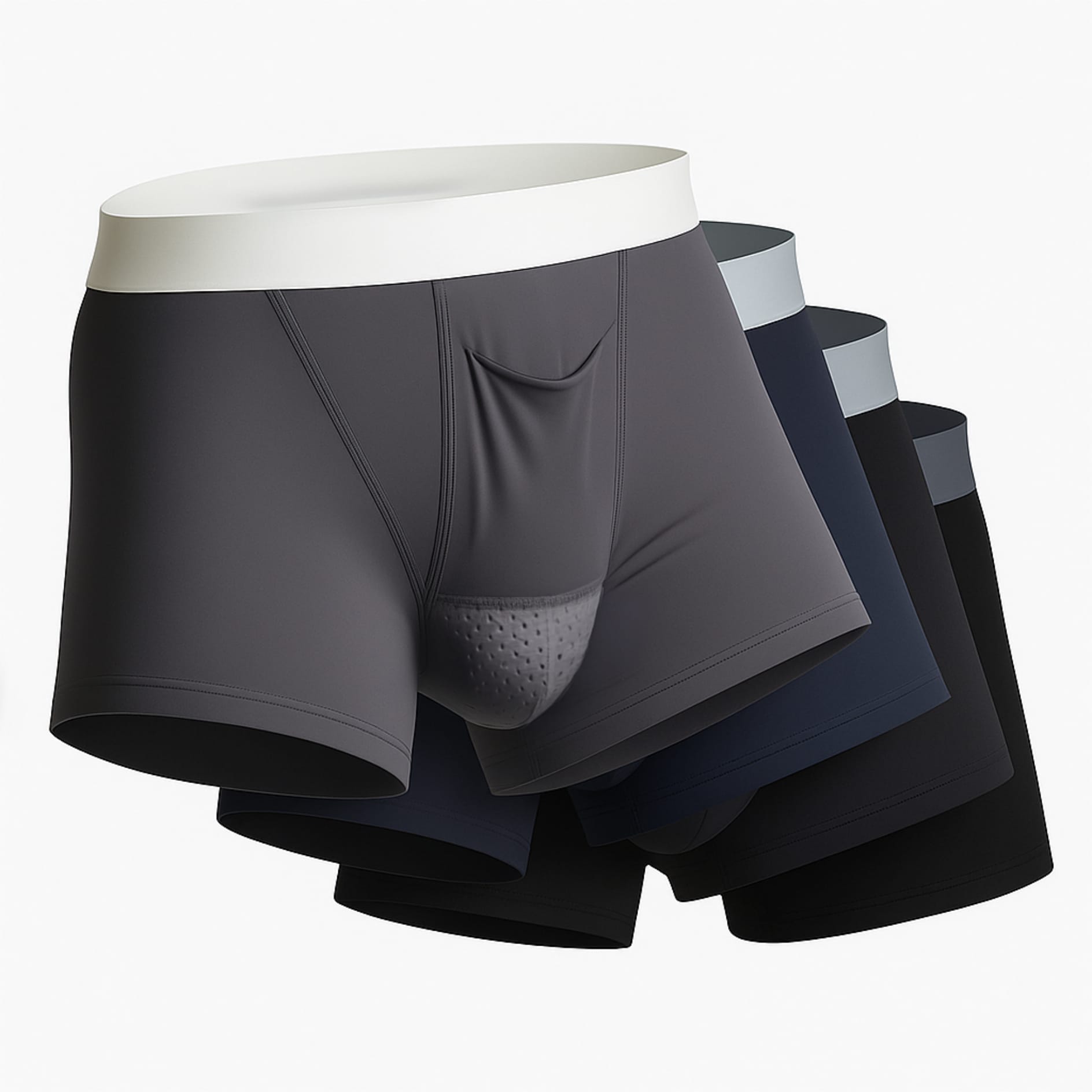
Underwear designed specifically for varicocele management differs from both standard underwear and athletic supporters in several engineering specifics. A well-designed varicocele support garment incorporates a contoured anatomical pouch that lifts and separates without compressing, graduated support zones that reduce venous pressure without cutting off circulation, moisture-wicking and thermally conductive fabric that actively reduces scrotal temperature, and full-day wearability without pressure point discomfort.
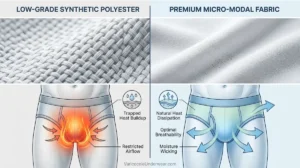
The thermal component is critical and absent in jockstraps. Scrotal heat stress in varicocele is a primary sperm damage mechanism, and fabric that wicks moisture and conducts heat away from the scrotal surface provides passive cooling throughout the day. Research on fabric and scrotal temperature consistently shows that tight-fitting garments without moisture management significantly elevate scrotal temperature compared to well-designed breathable support, with measurable consequences for spermatogenesis.
| Feature | Jockstrap | Varicocele Support Underwear |
|---|---|---|
| Scrotal suspension | Firm but rigid, impact-focused | Anatomical lift, venous-pressure-optimized |
| Thermal management | None (open design) | Active: moisture-wicking, cooling fabric |
| All-day comfort | Low (pressure points, leg straps) | High (designed for continuous wear) |
| Sitting adaptation | Poor (rigid pouch shifts) | Good (flexible anatomical design) |
| Inguinal support | None | Present (full coverage) |
| Fabric breathability | Variable (often cotton) | High (micromodal/performance fabric) |
| Post-surgical suitability | Adequate short-term | Preferred for extended recovery |
| Daily wear for varicocele | Not designed for this purpose | Purpose-built |
What About Standard Briefs and Boxer Briefs?
Standard cotton briefs provide moderate scrotal support but with significant thermal drawbacks. Cotton retains moisture, raises scrotal temperature during physical activity and sitting, and loses its support structure after washing. The boxers vs. briefs debate for varicocele is genuinely nuanced: loose boxers reduce thermal burden but provide zero suspension (worsening venous pooling), while tight cotton briefs provide suspension but at the cost of elevated scrotal temperature. Neither end of the spectrum is ideal.
This is precisely why varicocele-specific underwear occupies a distinct category: it attempts to solve both sides of the problem simultaneously. The support prevents the gravitational venous pooling that briefs improve over boxers, while the fabric technology prevents the thermal elevation that briefs cause over boxers. If you’re choosing between tight underwear and its effect on varicocele, understanding that it’s not just about tightness but about the combination of support architecture and thermal properties is the key insight.
When a Jockstrap Is Still Appropriate
Jockstraps remain the appropriate choice for high-impact sports where impact protection is the primary concern (contact sports, martial arts), for very short-duration athletic activities (less than 1-2 hours) where all-day comfort is not required, and for immediate post-surgical support when a surgeon specifies a firm athletic supporter for the first 24-48 hours post-operatively. For extended post-surgical recovery, the post-varicocelectomy underwear guide recommends transitioning to purpose-designed support underwear once the initial acute recovery phase is complete.
The varicocele support and cooling underwear combines the scrotal lift of a jockstrap with the all-day wearability, thermal management, and anatomical design that daily varicocele management requires. For the 16-18 hours a day you’re awake and mobile, the support garment you wear has a cumulative impact on venous pressure and scrotal temperature that far exceeds the effect of any single intervention.
FAQ: Varicocele Underwear vs. Jockstraps
Can I wear a jockstrap every day for varicocele management?
You can, but most men find daily jockstrap wear uncomfortable beyond 4-6 hours due to the leg strap pressure and rigid waistband design. The comfort barrier leads to inconsistent wear, which defeats the purpose of continuous scrotal support for varicocele management. If comfort prevents consistent daily use, the support garment that gets worn reliably is medically superior to the theoretically better one sitting in a drawer.
Does the pouch design of underwear matter for varicocele?
Yes, significantly. A contoured anatomical pouch that lifts the scrotum upward and slightly forward, without lateral compression, reduces hydrostatic venous pressure while maintaining scrotal separation (which itself aids in thermoregulation). Flat or minimal pouches that allow the scrotum to hang naturally provide little hemodynamic benefit. Look for structured pouch architecture with upward lift geometry rather than simple forward separation pouches designed for comfort rather than venous support.
What underwear do urologists recommend after varicocele surgery?
Most urologists recommend a supportive athletic supporter or firm scrotal support for the first 48-72 hours after surgery, transitioning to supportive underwear designed for extended daily wear during the remainder of the 4-6 week recovery period. The 2026 evidence-based best underwear for varicocele guide reviews specific options across the recovery and long-term management spectrum with criteria grounded in the relevant thermal and mechanical research.
Related Articles
Choose Varicocele Support Designed for Cooling, Lift, and Daily Comfort
You’ve seen why regular underwear often falls short. Now view the purpose-built option made to reduce heaviness, improve support, and feel comfortable enough for everyday wear.